Disclaimer:
This guide is an overview document aimed at providing the reader with an understanding of the general principles applicable to the Commissioning. None of the information provided in this guide is to be seen as a professional advice. Project specific guidelines and specifications must be established by licensed professionals, based on the process and equipment specificities and manufacturers' requirements. Project's specifications and manufacturer's guideline provided in the shop drawings and manuals always take precedence on the information provided here. SynQ Consulting will not accept any claim of responsibility and will not be held responsible for personal damages and/or material damages and/or liquidated damages and/or any other kind of damage resulting from the use of this guidelines. The reader acknowledges that decisions taken based on the information contained in this guideline remain his/her entire responsibility. The reader recognizes that all specifications, procedures, and activities must meet applicable local laws and codes, the manufacturers' recommendations and be approved by a licensed professional.
Commissioning objectives
The commissioning main objectives are:
- Facilitate the transition between the construction phase of the project to the operation phase in a systematic manner;
- Perform the first start of the facility's equipment in a safe and efficient way;
- Ramp-up and demonstrate the compliance of the systems with the technical and performance specifications;
- Assist and facilitate the knowledge transfer between the design, procurement and construction groups to the operation group;
To achieve those objectives, the commissioning group will:
- Review the engineering specifications against the project's perfromance objectives;
- Plan the systematic delivery of portions of the work into functionnal units
- Review and ensure the readyness of the functional unit by performing pre-startup inspections of the physical installations and reviewing objective evidences of successful testing;
- Gradually start and test the functionnal units;
- Gradually integrate functional units into functionnal processes;
- Ensure required operational documents and training are provided to the operations team;
- Assist operation teams during ramp-up to full production.
Commissioning has been around for quite some time in the industrial facilities, with the mission to perform the initial start-up of the installations and facilitate transfer of the operational knowledge to operations teams. Successful commissioning work shall comprise all of safe, systematic and efficient start-up and ramp-up of complex processes. Historically, commissioning groups developped in an effort to optimize start-up speed and reliability since delays, off-spec or unreliable processes impaired the return on investement of the project.
Commissioning in the buildings is more recent and has been introduced in large part by initiatives like ASHRAE and LEED to ensure building systems are efficient - mainly energy wise - therefore reducing their environmental impact. While substainability is often seen as a trade-off with costs, the introduction of commissioning helps not only to ensure specifications compliance, but also equipment longevity and operations efficiency, thus normalizing the afformentionned trade-off.
Contractors
Well planned, realized and documented, commissioning lower the risk of future claims and facilitate operation and mainteance work. The perception of the owner and/or operator is likely to last long after the end of construction. In consequence, successful collaboration to the commissioning process is one of the easiest and best free - or inexpensive - retention marketing.
Owner and operator
Commissioning is a project's level function and as such, falls under the direct responsibility of the project management. On many projects, the commissioning responsibility is contractually delegated to the general contractor. This is problematic because it creates a discontinuity in the knowledge retention between the realisation phase and the exploitation phase. In such instance, a comprehensive knowledge transfer program must be developped to ensure exhaustive transition of the know-how to the operator.
Commissioning in the project's life cycle:
Commissioning is a functional division of a project. It is bound to pursuing the global projects objectives but shall remain independant from the other project groups - such as the design, procurement or construction - specific objectives and constraints.

Functions
- Review and auditing function for two main stage gates: Design review and Mechanical completion.
- Execution function from Mechanical completion to Start-up (including performance testing) and for de-commissioning.
- Support function from Start-up to Stable Operation and post-commissioning (or re-commissioning).
Commissiong Scope of work
Commissiong Scope of work structure
The commissioning scope of work structure is divided into three levels:
- Block or process flow: This upper level must be aligned on the process as designed and is not likely to change when the preliminary design is frozen. It is intended to show only the major functionnal divisions of the process. It is intended for the high level understanding of the process and development of the next levels of the commissioning scope of work.
- Systems structure: At this secondary level, All the functionnal process divisions are defined and the distinction between the pure process systems and utility systems is made. As a guideline, a system is a fully functionnal unit, comprised of upstream feed input, downstream consummer output, power input(s) and utilities input(s) and output(s), complete autonomous automation.
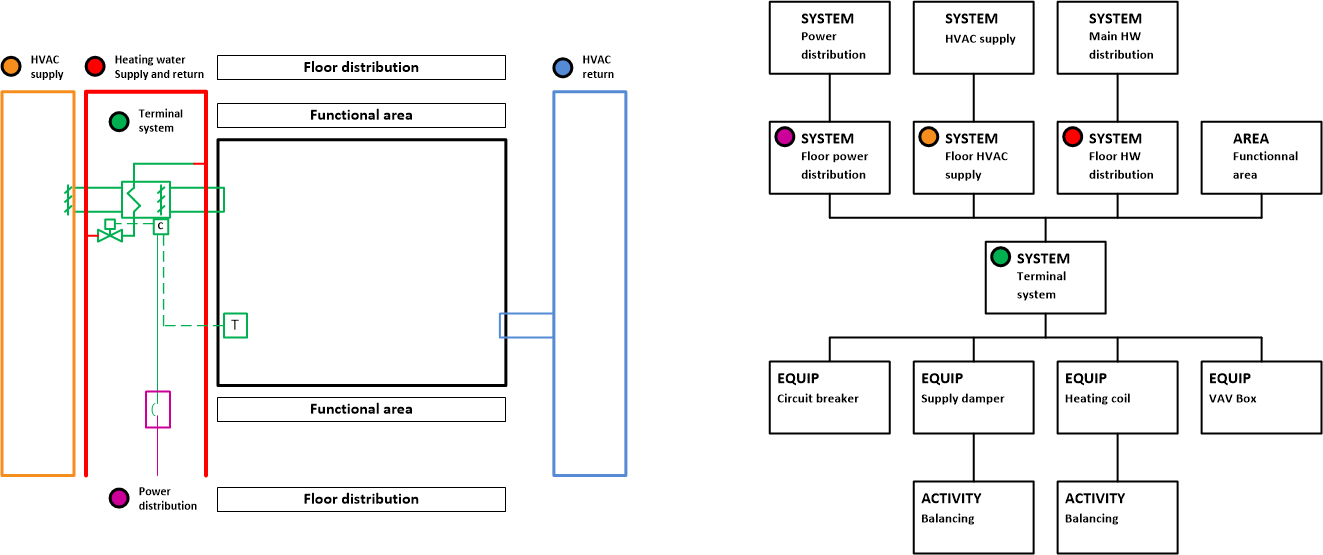
- Sub-systems structure: This third and final level will set the precedence requirement for the systems inputs and outputs. For a given system, if three streams feed three different systems downstream, this system would be divided into three distinct sub-systems, thus allowing for each sub-system completion to be aligned with the requirements of the downstream systems. As a rule of thumb, isolation points like a valve, a damper and a circuit breaker are natural sub-systems divisions.
- Equipement assignment: Equipment are assigned to sub-systems regardless of the disciplines. All equipment required to make the sub-system a functionnal unit must be assigned: mechanical equipment, electrical equipment, piping or ducts networks, automation loops.
Building vs industrial process
In industrial facilities, there is a clear distinction between process and utility systems. In a nutshell, the process stream is the one transforming the intrants into a finished product. Utilities are all the anciliaries required for the process to operate, without being direct intrants of the final product.
In the building construction, the process can be assimilated to the building spaces as the utilities consummers. All the utilities systems such as the pulsed air distribution system, the cooling water system and the lighting system - among others - are feeding the spaces providing defined environmental conditions as the final product. In small buildings, the process sub-systems can be fairly simples, eg floor based units. In more complex buildings such as an hospital, sub-systems would be based on the functional nature of the floor plan. An operating room, even if only a fraction of a floor could be an entire sub-system as it is fully functionnal with its dedicated HVAC terminal system.
Commissioning Inspection and test plan
A comprehensive plan of the inspection and testing activities required to ensure the safety, the compliance and the performances of every systems must be developed. At this level, all the activities as required by the regulation, the standards,the specifications or the rules of the art must integrated for each type of equipment. For each distinct activity, a comprehensive procedure must be developed, including at least:
- Full Safety assessement of the activity;
- Detailed list of operations to perform;
- Data and/or evidences to gather;
- Procedure to follow in case of non-conformity;
- Report(s) to produce and retention procedure;
- Expertise and/or certifications required to perform the activity.
It is important to note that at this stage, the procedures are not equipment specific. Therefore, mentions to specific switches, HMI messages, numeric results, etc are not expected.
Commissioning Tracking matrix
Commissioning Inspection and test plan must now be exploded as much as required to assign activities to all equipment, sub-systems and systems of the above defined Commissioning Scope of work.
Each activity from the Commissioning Scope of work shall carry a specific work instruction defining the specific safety measures, operations and boundaries for inspection or test acceptance according to the associated equipment make and model. In most case, it is easier and faster to gather the applicable sections of the operation and maintenance and to attach a tailored test report pre-filed with the allowable results tolerances.
Commissioning Schedule
In conjunction with the project and construction schedules, a required completion date and duration must be assigned to each activity of the Commissioning Tracking matrix. Then, with the help of a scheduling algorithme, the late start date of each activity must be computed and propagated to the sub-systems and systems.
Once a preliminary scheduled Commissioning Tracking matrix as been established, material and manpower requirement and availability must be investigated and the schedule must be adjusted accordingly.
Commissioning manpower
Manpower requirement must be planned for the execution of each commissioning activities as well as for the general functionnality of the commissioning department.
- Commissioning organization starts with the commissioning manager assisted by various engineers having strong expertise in each type of systems found on the project.
- Various specialists, usually from project organization, are appointed to support health, safety and environmental, planning, procurement, project control and document control functions.
- Technicians, often employed by the equipement manufacturer or specialized laboratories, are appointed for specific commissioning activities.
- Construction teams are sollicitated for installation work completion, modifications or adjustment.
- Owner or operators are appointed for knowledge transfer and start-up assistance.
As much as possible, as the construction workload diminishes, it is recommended to transfer expertise from the construction department to the commissioning department in an effort to capitalize on accumulated know-how.
Interactions with the construction team
As stated previously, construction team work on a work packages basis. In order to efficiently dispatch the corrective work, commissioning requests must be adressed to the construction team on that basis. In most cases, the highest level in the commissioning matrix at which both the work packages and process systems merge reasonably is the equipement level. Therefore, the commissioning matrix shall keep a link with the construction work packages and the equipement to facilitate communications.
Commissioning workflow
Planning
Planification phase is without a doubt the most important step for successuful and profitable commissioning. This includes:
- Preparing the scope of work;
- Developping the schedule;
- Establishing the organization matrix;
- Developping the procedures, work instructions and report sheets
The most important element to take in consideration when planing the commissioning activities is the shift between work packages management and process systems management happening at the time of mechanical completion.
Up to mechanical completion, all teams working on project's management organize their planing and project's control around the sub-contracts issued to the equipment suppliers and installation contractors. Therefore, the trades/disciplines link is strongly reflected in all constructions activities management. For example, the contractor responsible for the installation of the plumbing in a given area will plan and expedite all the plumbing work, regardless of the specific processes involved. Also, documents submission and retention is generally organized around the work packages being the upper level container.
After mechanical completion, the management of the project shifts to a processes based organization and the work is then very weakly linked to the discipline concept. The art of commissioning at the design and planning phases of the project is to ensure smooth completion of all the construction activities into functionnal units without impairing the construction performances. As a matter of fact, even if it would seem interresting to complete a functional unit very early in the project's construction phase and begin hands-on commissioning work along construction activities, this would likely not be efficient or possible. Many trades involved early in the construction phase, such as those responsible for building superstructure must work in bulk to maintain efficiency. Therefore, commissioning schedule must be thoroughtly challenged and aligned with the construction team schedule.
As demonstrated above, the shift from work packages management to process systems management must be carefully planned and full adhesion of the project management team is crucial. Over and above, commissioning objectives must be communicated early and clearly to the design and construction teams and project control systems must be designed to ensure strong anchoring between both philosophies.
Contractors
Careful commissioning planing will help in setting the construction priorities and may serve as a risk mitigation tool. In the event of an unforseem delay in the construction activities, it is often possible to offset the negative consequences by mitigating the consequences of the adverse event into the lower priority systems.
Execution
Execution starts when the mechanical completion milestone of a sub-system is reached. It is good practices to formalize the acceptance of mechanical completion by a formal letter or certificate. Even if the construction and commissioning is performed by the same organization, formal acceptance of the mechanical completion will help preventing early appropriation of sub-systems or delayed appropriation. While delays are obviously detrimental to projects schedule and budget, early appropriation adds risk for the safety of the personnel and the installations.
Mechanical completion requirements:
- Installation is completed per specifications;
- All dry tests are completed and successful;
- Final inspection reveals no defects affecting safe and sound start-up;
- Inspection and testing reports are approved, filed and available;
- O&M manuals are approved, filed and available;
- As-built drawings, datasheets, equipment lists and other pertinent documents are approved, filed and available.
Once mechanical completion is formalized, the following preparatory steps shall be systematically performed:
- readiness review (walkdown and punchlist assessement);
- health and safety programs transition
- lock-out and tag-out activities.
Safety
Health and safety must be paramount for the commissioning team. The start of the commissioning activities mark a turning point and a major change in the project conditions. What was previoulsy a static installation now becomes a dynamic system involving the presence of energy, chemicals, and several other hazards that extensively change the safety conditions of the teams already on site. Prior safety assessments are no longer valid or exhaustives and cohabitation of construction team along commissioning and operation teams exhacerbate the complexity of hazards management and mitigation. A specific guide on commissioning Health, Safety and Environmental planning is provided on our web site to stress the criticality of this topic.
When the sub-system is fully secured, sequential execution of the activities can be started:
- Pre-commissioning: cleaning, lubrication, removal of temporary bracing, etc;
- Dry commissioning: powering equipment without fluids and testing instruments loops and interlocks;
- Wet commissioning: starting equipment with inert fluids and testing functionality and performances;
- Hot commissioning: Introducing process fluids and adjusting operating parameters;
- Ramp-up and performance testing: Increasing load until systems operate at rated load and performance;
- Stable operation: transfering custody of the systems to the owner / operation teams;
- Re-commissioning: re-assesssing equipement conditions and performance at pre-determined intervals.
Building
Because in building systems, most of the process fluids are inert fluids, hot commissioning often follows dry commissioning. Notable exeptions are the combustible gas and oil systems and, to some extent, steam systems.
Control
As the comissioning activities progress, the following controls shall be performed:
- Measuring progress against the schedule baseline;
- Documenting and retaining:
- Inspections and tests results;
- Deficiencies and non-conformities;
- Process and set-points changes and adjustment;
- Trainings progress
- Trending commissioning performances and reviewing procedures as required